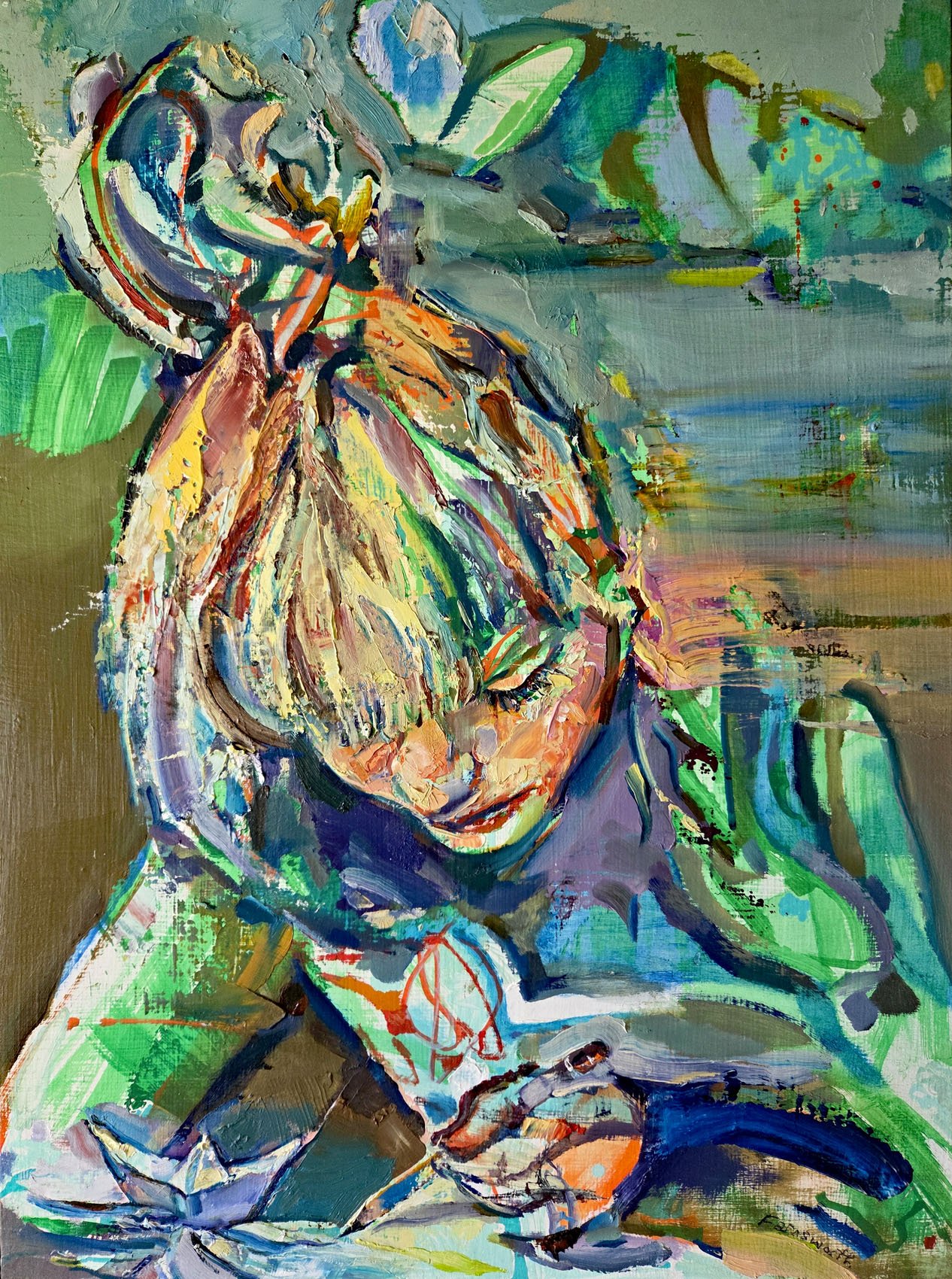
Pesquiers Drawing Meditation, 2026. Oil and acrylic on panel, 24 x 18 inches.
My painting, Pesquiers Drawing Meditation, will be included in a group exhibition at Salin de Pesquiers, Giens Peninsula, on the south coast of France in September 2026.
“Enchantments”
Salin des Pesquiers, Giens Peninsula, France 1-20 September 2026
An art exhibition in a natural environment is a challenge, as nature is itself spectacular, a ground for fascination. The salt fields on the Giens Peninsula near Hyères on the Mediterranean coast are no exception.
“The Salin des Pesquiers takes its name from its primary purpose as a fishery. It is located in the heart of the double tombolo of the Giens Peninsula (double sandy land strips connecting an ancient island to the continent). [...]. Before 1848, this double tombolo once surrounded a single coastal lagoon which was exploited for centuries as an active fishing ground [...]. Gradually, the entire lagoon was developed into a salt pan of a size and mode of exploitation conducive to industrial salt production. Today, the Salin des Pesquiers constitutes a coastal wetland of approximately 550 ha made up of a mosaic of bodies of water of varying depth, surface and salinity, from which arises a great diversity of natural habitats [and an] exceptional biodiversity. The natural landscapes it offers contribute to marking the exceptional character of the Giens Peninsula wildlife.”
With this description in mind, “Enchantments” seeks artworks (painting, drawing, photography, video/film, creative writing, sound, performance, prints [lithographs, etchings, screenprints etc.], computational art, sculpture) which address the dreamy perspectives and fragile ecosystem of the salt fields. This experimentation with absorption may take place onsite or from far away. In common is the imagery of salt marshes, flatlands, and the coastal environs as well as reverie in a natural environment. Reverie implies being lost or absorbed in one’s thoughts or in the contemplation of something exterior to us. In France, the best-known literary example is Jean-Jacques Rousseau’s Reveries of the Solitary Walker (Rêveries du promeneur solitaire) in the eighteenth century, a period in which absorption was often represented in the visual
arts. But Michael Fried demonstrates in his Absorption and Theatricality that this type of concentration, far from being a reverie, expressed a “need to return to what were perceived as the high seriousness, elevated morality, and timeless esthetic principles of the great art of the past.”
Today, climate change caused by human overconsumption gives new meaning to reverie and absorption. In 2014, philosopher Bernard Stiegler declared “‘the age of less’ – less resources, less room for maneuver, less confidence, less hope [d’espoir]” and the necessity “to situate [oneself] on the side of being rather than of having.” The title of his manifesto, The Re-Enchantment of the World, is a sober but compelling call that challenges us all, especially those of us who wish to reflect in both creative and critical ways on the power, resilience and fragility of nature.
The Salin des Pesquiers presents an ideal context in which to engage with the theme of enchantment. Whether experienced in person or contemplated from afar, we will open ourselves to the enchantments of a natural site transformed over centuries through human intervention, now returned to the Mediterranean Sea and a refuge for wildlife. Among those who have addressed the questions which arise when faced with aesthetic absorption is the literary critic Rita Felski, who offers a form of solace when she writes: “Possessing some of the viscerality of shock, enchantment has none of its agitating and confrontational character; it offers rapturous self-forgetting rather than self-shattering.” If this form
of enchantment “is something elusive,” it too has “an ineffable and enigmatic quality.” We invite you to discover what this may be.